
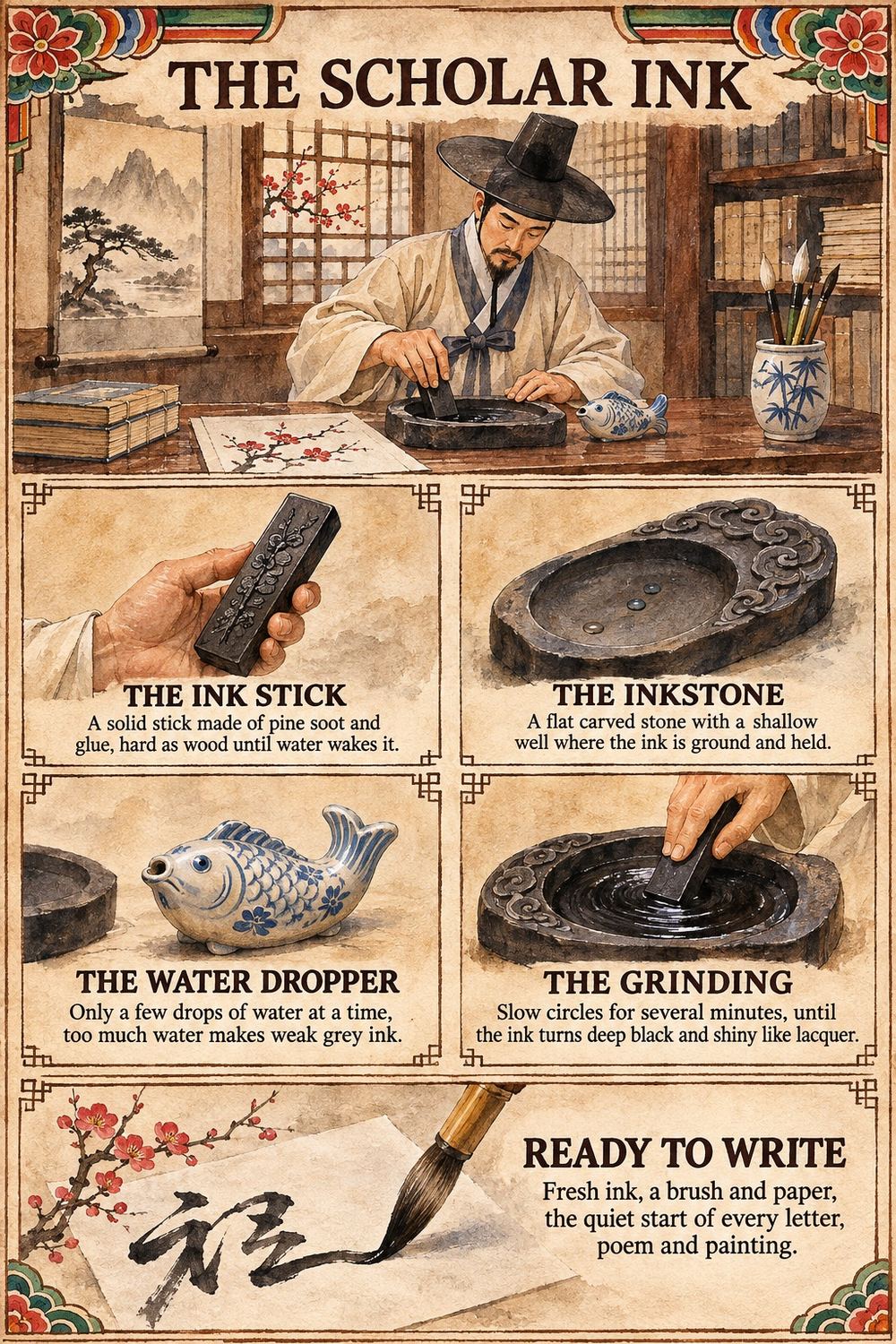
Before a Joseon scholar wrote a single character, he made his ink himself, by hand, from a dry black stick. There was no bottle to open. Ink was a small ritual at the start of the working day in the study, the sarangbang, and it set the pace for everything that followed: slow down, clear the surface, clear the mind, then write. Our poster, The Scholar Ink, shows that ritual in one scene at the top and then breaks it into its parts underneath.
At the top of the poster the scholar sits at his low desk in a light hanbok and the tall black horsehair hat, the gat, worn by Joseon gentlemen. Behind him are bound books on shelves, a hanging landscape scroll, a lattice window, plum blossom, and a porcelain jar holding his brushes. In front of him are paper, a painted sheet, and in the centre of the desk the three objects this article is about: the ink stick in his hand, the round inkstone under it, and the small fish-shaped water dropper beside it. Together with the brush and paper, the ink stick and inkstone belong to what Korean and wider East Asian tradition called the treasures of the study: the everyday tools a scholar was expected to know, care for and judge by quality.
The Ink Stick
The first panel, bottom left, shows a hand holding the ink stick up close. As the poster says, it is a solid stick made of pine soot and glue, hard as wood until water wakes it. To make a stick, fine soot, traditionally collected from burning pine wood, was mixed with animal glue, kneaded into a paste, pressed into a mould, and dried until it became hard and lasting. Good sticks could be kept for years in a drawer without spoiling, which is exactly why the method survived for centuries: the ink waited, dry and stable, until the scholar needed it. Many sticks were decorated on the surface, and the one in the poster carries a moulded floral design along its length, as real sticks often did with carved patterns, calligraphy or makers marks.
The Inkstone
The panel to its right is The Inkstone: a flat carved stone with a shallow well where the ink is ground and held. The inkstone is both the grinding surface and the reservoir. Its flat slope is where the stick moves, and its deeper well is where the finished ink collects, ready for the brush to dip. A good stone had to be smooth enough to grind finely, but with just enough texture to wear the stick down, hard enough to last generations, and it should not drink the ink too quickly. In the poster the stone is dark, heavy and carved around the rim with swirling cloud patterns, the kind of careful decoration that turned a working tool into an object a scholar kept for life and sometimes passed on.
The Water Dropper
Below the ink stick is The Water Dropper, and it is the smallest, cleverest object on the desk. In the poster it is a blue and white porcelain fish, with its mouth as the spout. A water dropper, yeonjeok in Korean, holds a small amount of water and releases it in controlled drops onto the inkstone. As the poster stresses, only a few drops of water at a time, because too much water makes weak grey ink. That control is the whole skill. Start with very little water, grind, judge the darkness and shine, then add another drop if needed. You can always thin ink a little more; you cannot easily take water back out. Porcelain droppers were made in many playful and symbolic shapes, animals, fruit and figures among them, so even this tiny tool carried decoration and meaning into the study.
The Grinding
The fourth panel, The Grinding, shows the work itself: a hand holding the stick upright and moving it in slow circles on the wet stone, ripples spreading through the blackening water. The poster says it plainly, slow circles for several minutes, until the ink turns deep black and shiny like lacquer. Grinding was not rushed. The stick is held straight, pressure stays even, and the motion stays circular so the ink becomes fine and even rather than gritty. The shine matters: when the liquid ink starts to look glossy and deep, the soot and glue have mixed properly and the brush will carry a rich, clean black. Scholars treated these minutes as preparation in both senses, making the material and settling into the right state of mind before writing, painting, or starting an examination answer, a letter, a poem or an official document.
Who lived this routine? Above all the yangban, the scholar officials of Joseon Korea, for whom calligraphy was not a hobby but a daily duty and a mark of education and character. Students preparing for the state examinations, government officials drafting documents, poets, painters and letter writers all began the same way, with the same three objects on the desk. A persons handwriting, and the care taken before it, said a great deal about the person in a culture that read character in brushwork.
Ready to Write
The wide panel at the bottom of the poster closes the sequence: Ready to Write. Fresh ink, a brush and paper, the quiet start of every letter, poem and painting. A large soft brush, loaded with the new ink, touches a sheet of paper beside a sprig of red plum blossom and leaves a bold black stroke. After all the grinding, this is the payoff, and the poster is right to call it quiet. Nothing about the process is instant, and that is the point that still lands today, when the poster reader may have a calligraphy set sleeping in a drawer. In old Korea the ink stick did not judge anyone. It simply waited, hard as wood, for a few drops of water and a few patient minutes to become ink again.
You can find more designs like this in the Burek Lab Etsy shop, and you can see this poster as a pin on our South Korea board on Pinterest, where this Old Korea series will keep growing, one poster every Saturday.