This is the complete Old Korea series: twelve posters, each explaining one traditional Korean object or custom — what it is, how it was made, who used it, and what its colours, motifs and rituals meant. From a scholar's ink stick to a New Year lucky pouch, the series is a walk through everyday life in old Korea, especially the Joseon period, told one poster at a time. Every poster below links to its live pin on Pinterest.
How Koreans Made Ink: The Ink Stick, Inkstone and Water Dropper
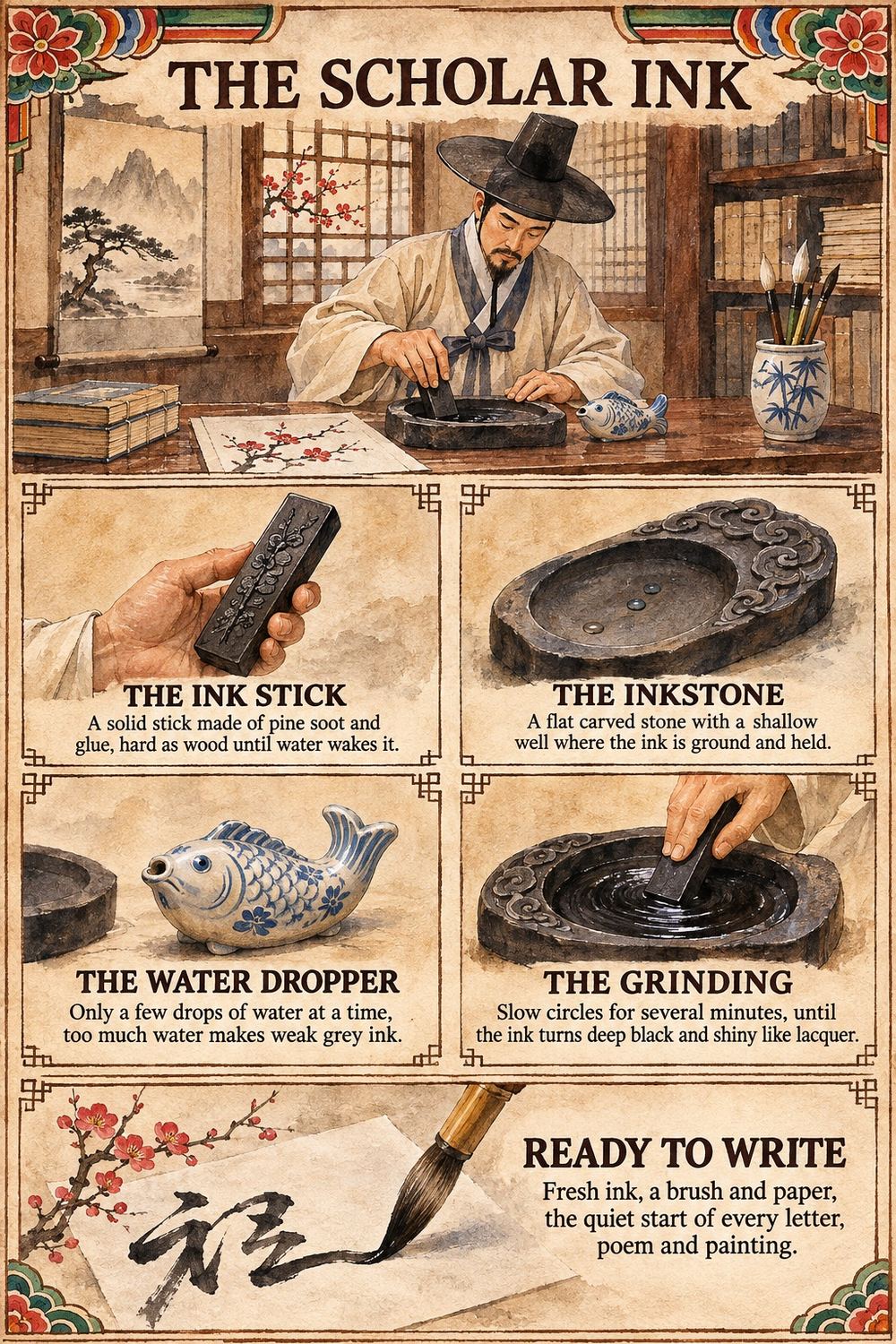
In Joseon Korea, writing began long before the brush touched paper. The poster opens with a scholar in a gat and hanbok at his desk, grinding ink in a quiet study with scrolls, books and brushes around him — the setting of the seonbi, the Confucian scholar whose letters, poems, exams and paintings all depended on this ritual. The four panels below explain the tools, together known as part of the treasures of the study. The Ink Stick was a solid stick of pine soot and glue, hard as wood until water woke it. The Inkstone was a flat carved stone with a shallow well where ink was ground and held. The Water Dropper, here a blue-and-white porcelain fish, released only a few drops at a time, because too much water made weak grey ink. The Grinding panel shows the slow circles, for several minutes, until the ink turned deep black and shiny like lacquer. The closing strip, Ready to Write, shows fresh ink, a brush and paper — the quiet start of every letter, poem and painting. See the pin on Pinterest.
Binyeo: What the Designs on a Korean Hairpin Meant
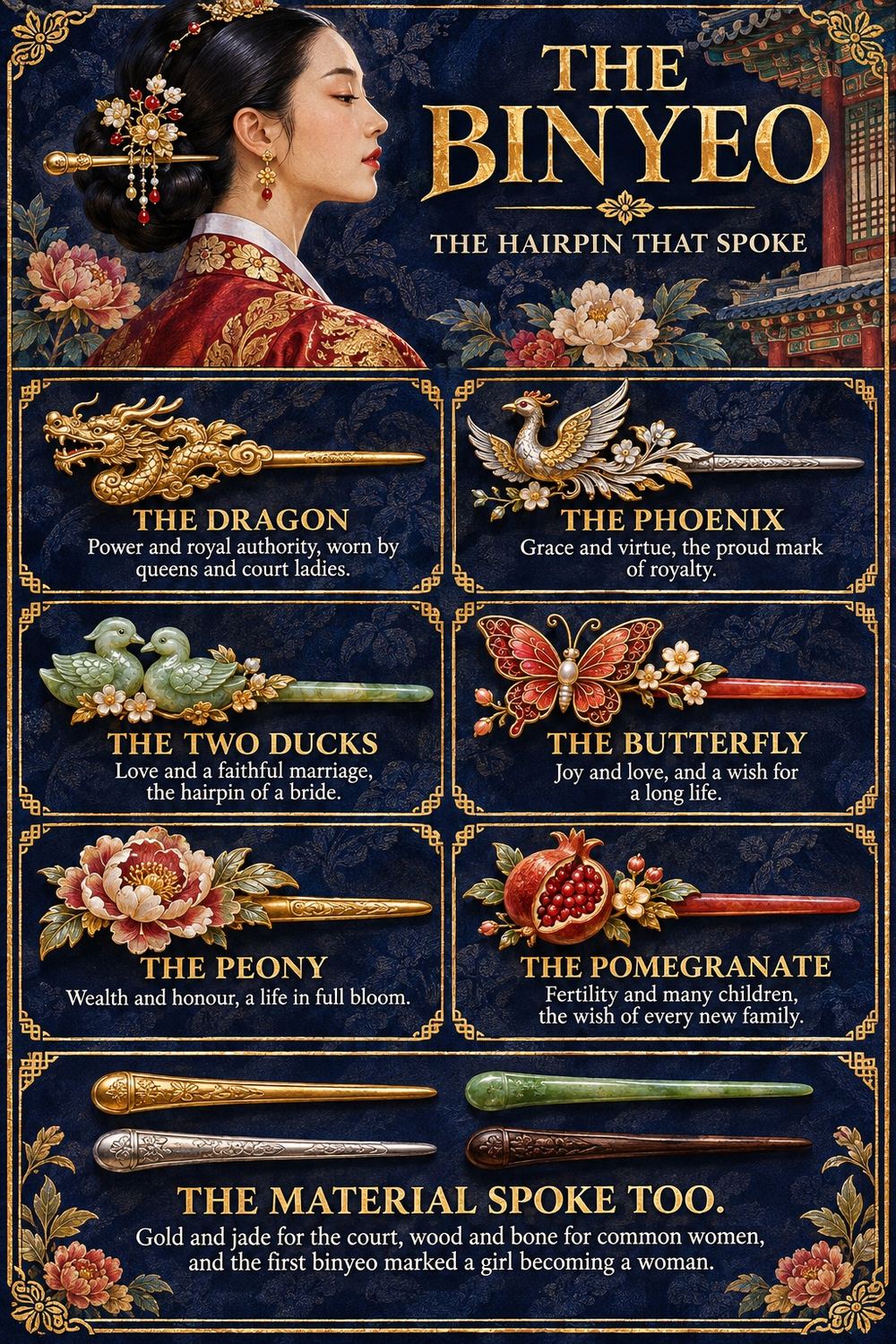
The binyeo was the long pin pushed through a married woman's bun to hold it in place, and in Joseon society it spoke before she did. The poster, titled 'The Hairpin That Spoke', shows a woman in a rich red hanbok, then six motif panels. The Dragon meant power and royal authority, worn by queens and court ladies. The Phoenix meant grace and virtue, a proud mark of royalty. The Two Ducks, carved in jade as a pair, meant love and a faithful marriage, the hairpin of a bride, because mandarin ducks pair for life. The Butterfly meant joy and love, and a wish for a long life. The Peony meant wealth and honour, a life in full bloom. The Pomegranate, split open to show many seeds, meant fertility and many children. The bottom band, The Material Spoke Too, explains the second language: gold and jade for the court, wood and bone for common women, and the first binyeo a girl received marked her becoming a woman. See the pin on Pinterest.
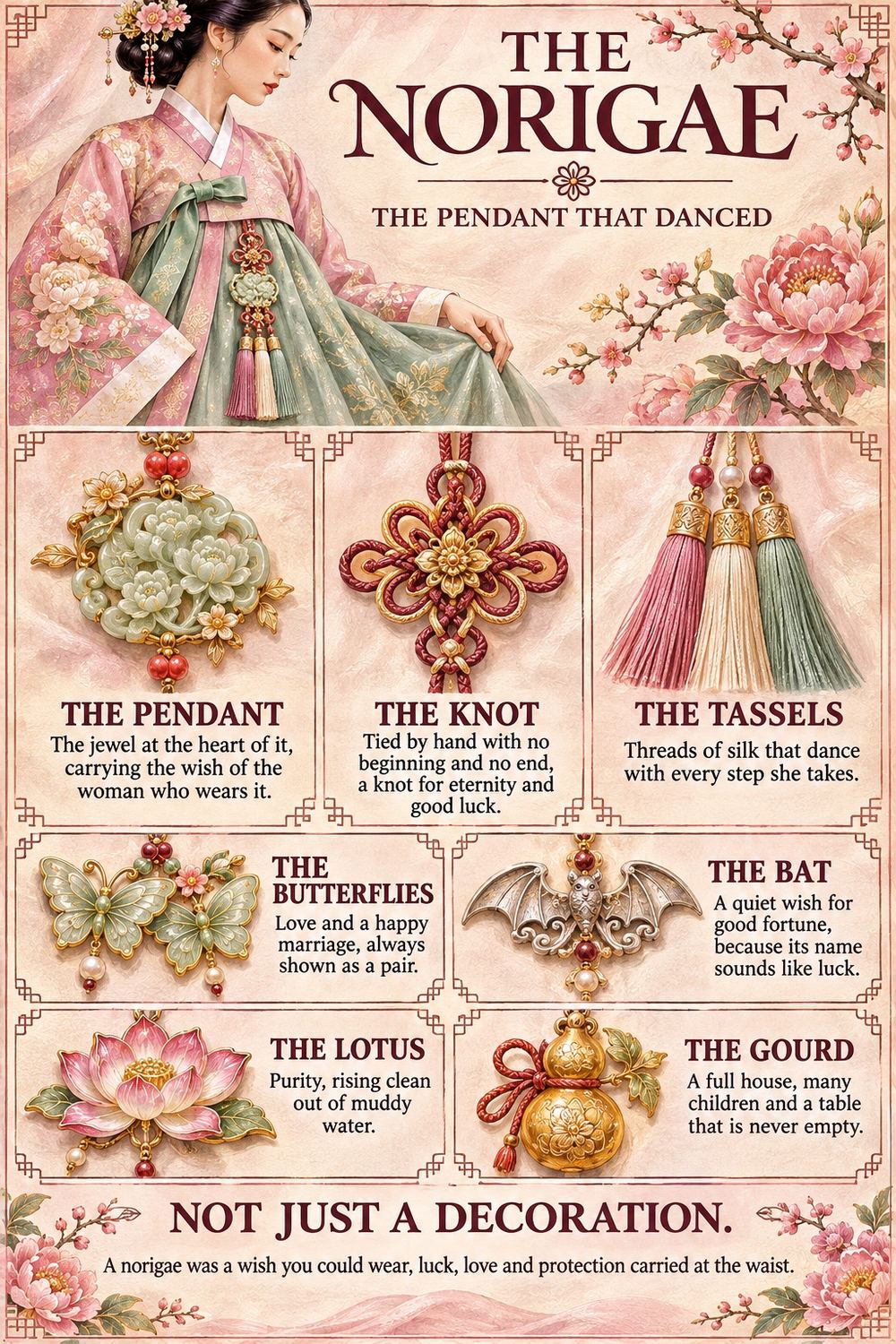
Norigae: The Korean Pendant That Carried a Wish
A norigae was the decorative pendant that hung from the goreum, the ribbon ties of a woman's jeogori, or from her skirt waistband, moving as she walked — which is why this poster calls it 'The Pendant That Danced'. It was worn on hanbok for formal occasions and holidays, by women across Joseon society, with finer materials for higher status. The poster breaks it into its three parts. The Pendant is the jewel at the heart of it, carrying the wish of the woman who wears it. The Knot (maedeup) was tied by hand in silk cord with no beginning and no end, a knot for eternity and good luck. The Tassels (sul) are threads of silk that dance with every step. Below, four common motifs: The Butterflies, always as a pair, for love and a happy marriage; The Bat, a quiet wish for good fortune because its name sounds like the word for luck; The Lotus, for purity, rising clean out of muddy water; and The Gourd, for a full house, many children and a table that is never empty. The footer sums it up: not just a decoration, a wish you could wear, carried at the waist. See the pin on Pinterest.
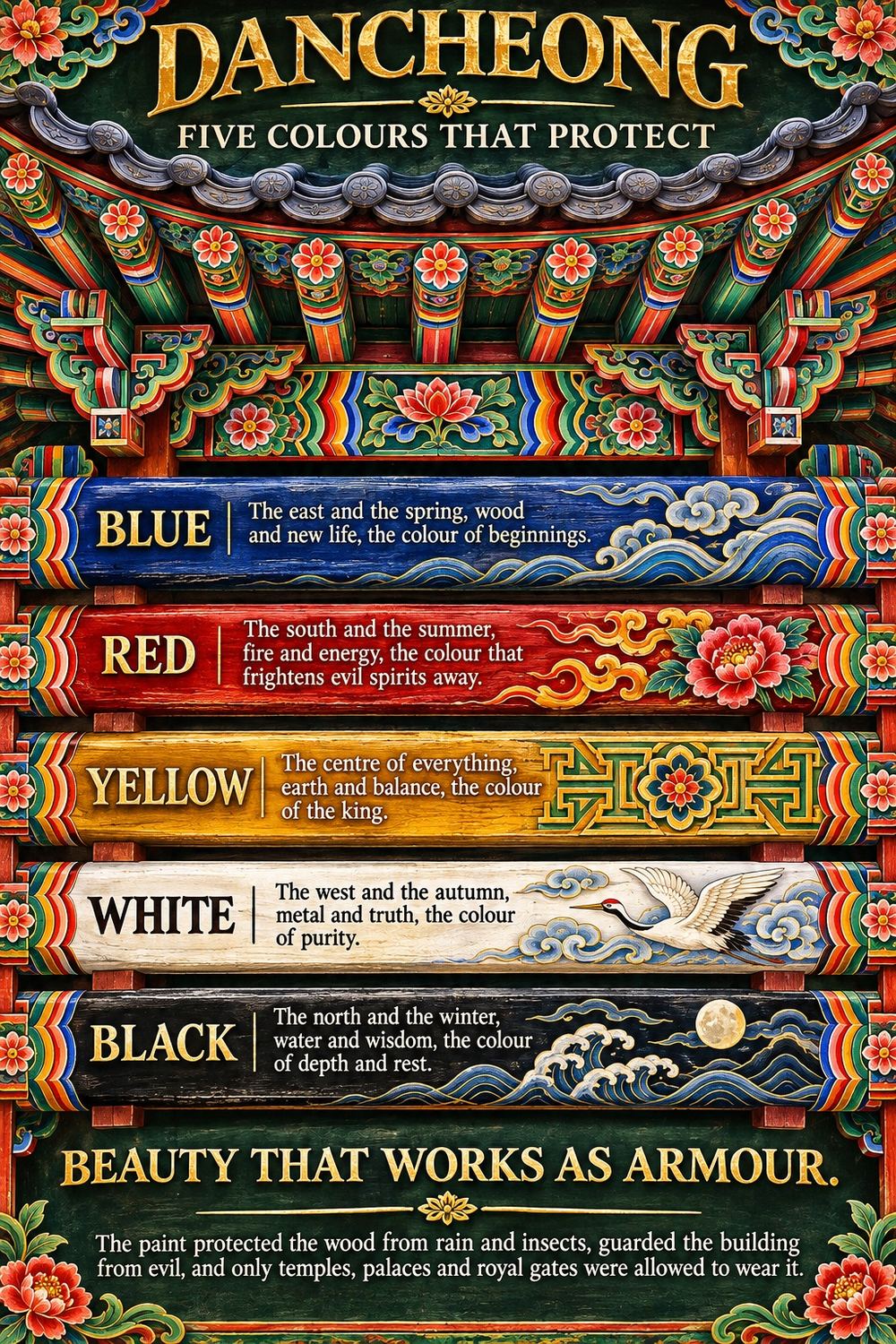
Dancheong: The Five Colours That Protect Korean Temples
Dancheong is the traditional painting applied to the wooden beams, brackets and eaves of Korean temples, palaces and royal gates. The poster opens on a curved tiled roof crowded with painted flowers and patterns, then lays out the five colours of obangsaek as five horizontal beams. Blue is the east and spring, wood and new life, the colour of beginnings. Red is the south and summer, fire and energy, the colour believed to frighten evil spirits away. Yellow is the centre of everything, earth and balance, the colour of the king. White is the west and autumn, metal and truth, the colour of purity, shown with a crane. Black is the north and winter, water and wisdom, the colour of depth and rest, shown with waves and the moon. The closing line, Beauty That Works as Armour, gives the practical reason: the paint also protected the wood from rain and insects, guarded the building symbolically from evil, and by rule only temples, palaces and royal gates were allowed to wear it. See the pin on Pinterest.
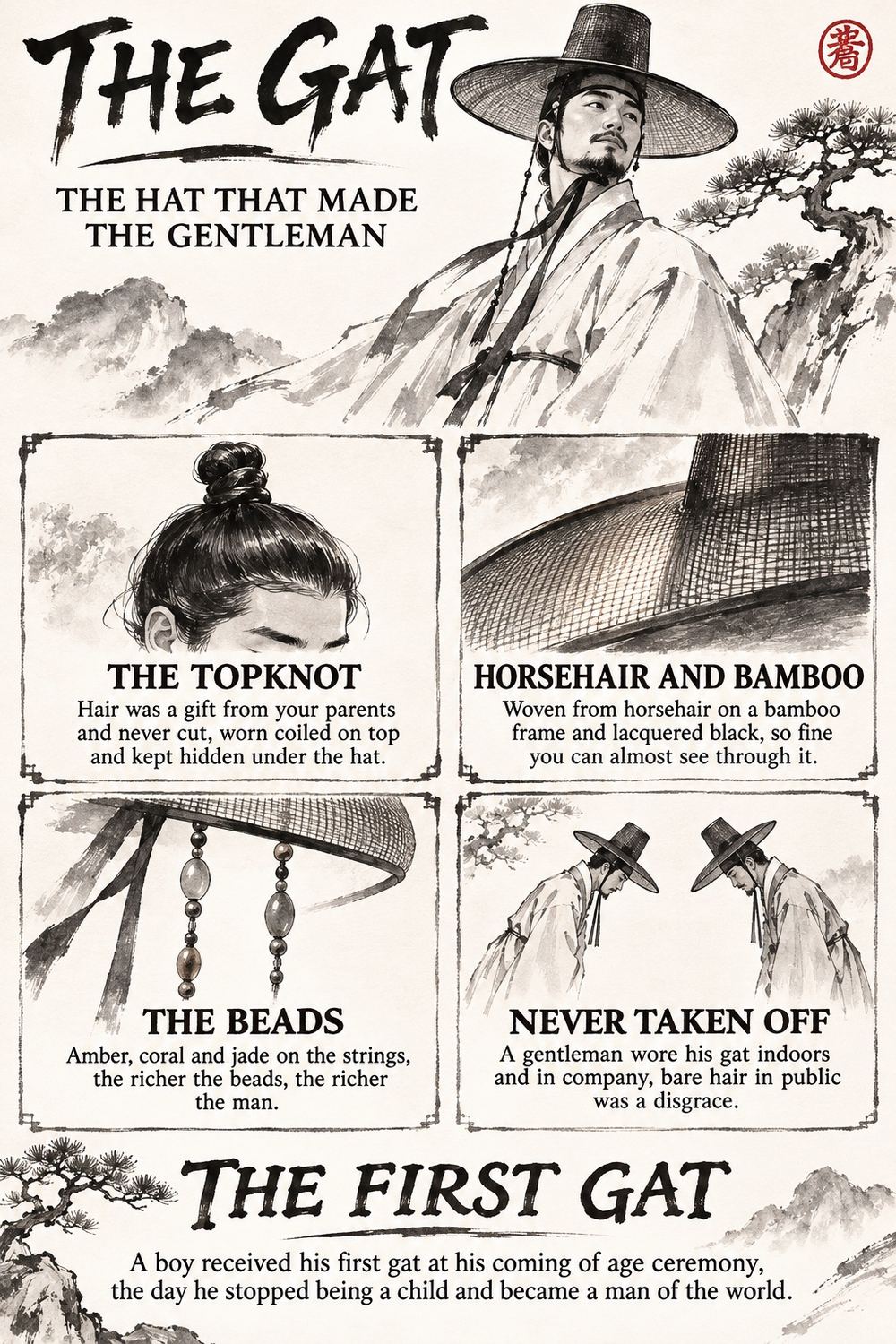
The Gat: The Horsehair Hat That Made the Joseon Gentleman
The gat was the tall, wide-brimmed black hat of the Joseon gentleman (yangban), and this ink-wash poster calls it 'The Hat That Made The Gentleman'. Four panels explain why. The Topknot: a man's hair was understood as a gift from his parents and was never cut; it was worn coiled on top of the head (sangtu) and kept hidden under the hat. Horsehair and Bamboo: the hat itself was woven from horsehair on a bamboo frame and lacquered black, so fine you could almost see through it — skilled, expensive work. The Beads: amber, coral and jade hung on the hat strings (gatkeun), and the richer the beads, the richer the man, so status showed at a glance. Never Taken Off: a gentleman wore his gat indoors and in company, and bare hair in public was a disgrace, which is why the panel shows two men bowing, hats still on. The footer, The First Gat, marks the life moment: a boy received his first gat at his coming-of-age ceremony, the day he became a man of the world. See the pin on Pinterest.
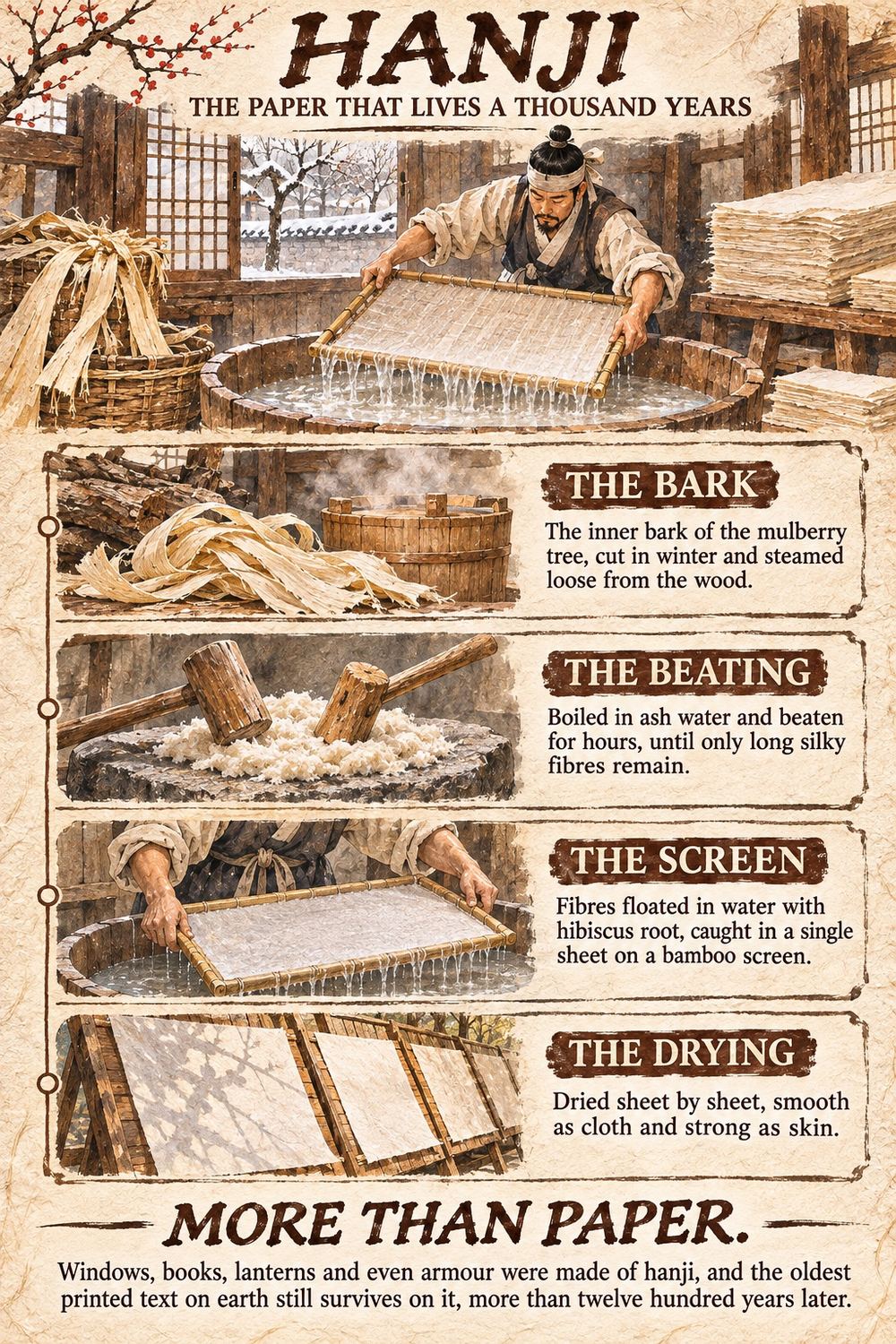
Hanji: The Korean Paper That Lives a Thousand Years
Hanji is Korean handmade paper, famous for lasting for centuries — the poster calls it 'The Paper That Lives a Thousand Years' and notes that the oldest printed text on earth still survives on it, more than twelve hundred years later. The top scene shows a papermaker lifting a fresh sheet on a bamboo screen from a vat. The process panels follow in order. The Bark: the inner bark of the mulberry tree (dak), cut in winter and steamed loose from the wood. The Beating: the bark was boiled in ash water and beaten for hours, until only long silky fibres remained. The Screen: fibres floated in water with hibiscus root mucilage to keep them dispersed, then caught in a single sheet on a bamboo screen. The Drying: sheets dried sheet by sheet, smooth as cloth and strong as skin. The footer, More Than Paper, lists why that strength mattered: windows (papered instead of glass), books, lanterns and even armour were made of hanji in old Korea. See the pin on Pinterest.
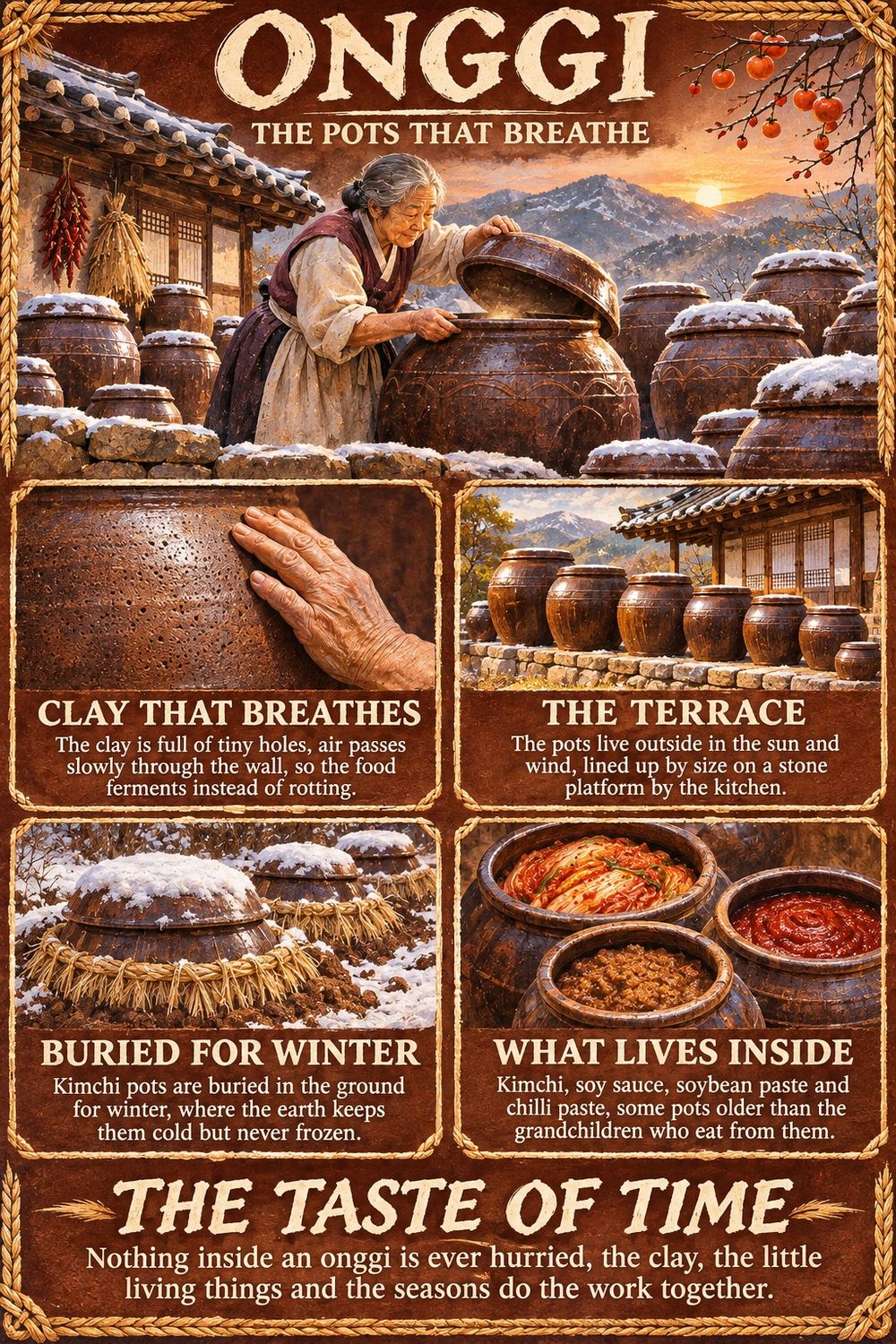
Onggi: The Korean Clay Pots That Breathe
Onggi are the large, dark brown earthenware pots used in Korea for fermenting and storing food, glazed and fired from clay. The poster, 'The Pots That Breathe', opens with a grandmother lifting a lid on a terrace full of pots dusted with snow. Clay That Breathes explains the key property: the clay wall is full of tiny holes, so air passes slowly through it and the food ferments instead of rotting. The Terrace (jangdokdae) shows where they lived: outside in sun and wind, lined up by size on a stone platform by the kitchen. Buried For Winter shows kimchi pots buried in the ground, where the earth keeps them cold but never frozen. What Lives Inside names the staples: kimchi, soy sauce (ganjang), soybean paste (doenjang) and chilli paste (gochujang) — some pots older than the grandchildren who eat from them. The footer, The Taste of Time, is the philosophy: nothing inside an onggi is hurried; the clay, the microbes and the seasons do the work together. See the pin on Pinterest.
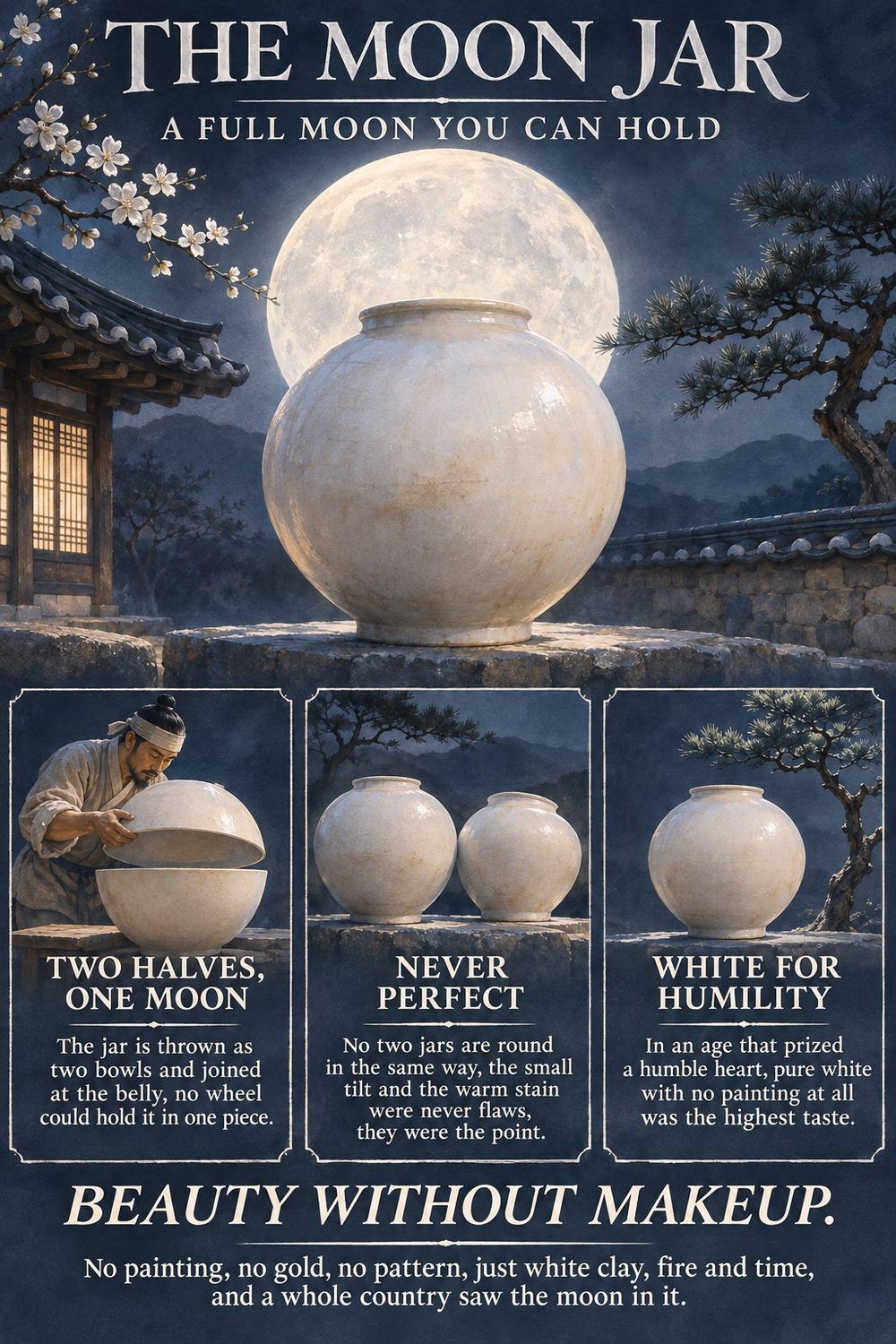
The Moon Jar: Korea's Full Moon You Can Hold
The moon jar (dal hangari) is the large, round white porcelain jar made in Joseon Korea, especially in the 17th and 18th centuries, prized precisely for its plainness. The hero image sets a jar on a stone platform directly in front of a full moon, so the two circles match. Two Halves, One Moon explains the making: the jar was too large to throw in one piece, so it was thrown as two bowls and joined at the belly, which is why the middle often bulges or tilts slightly. Never Perfect shows two different jars side by side: no two are round in the same way, and the small tilt and warm stain from firing were never treated as flaws — they were the point. White For Humility gives the Confucian value behind it: in an age that prized a humble heart, pure white with no painting at all was the highest taste. The footer calls it Beauty Without Makeup: no painting, no gold, no pattern, just white clay, fire and time, and a whole country saw the moon in it. Large moon jars were used at court and in wealthy homes for storage and display, including for wine or as flower vessels. See the pin on Pinterest.
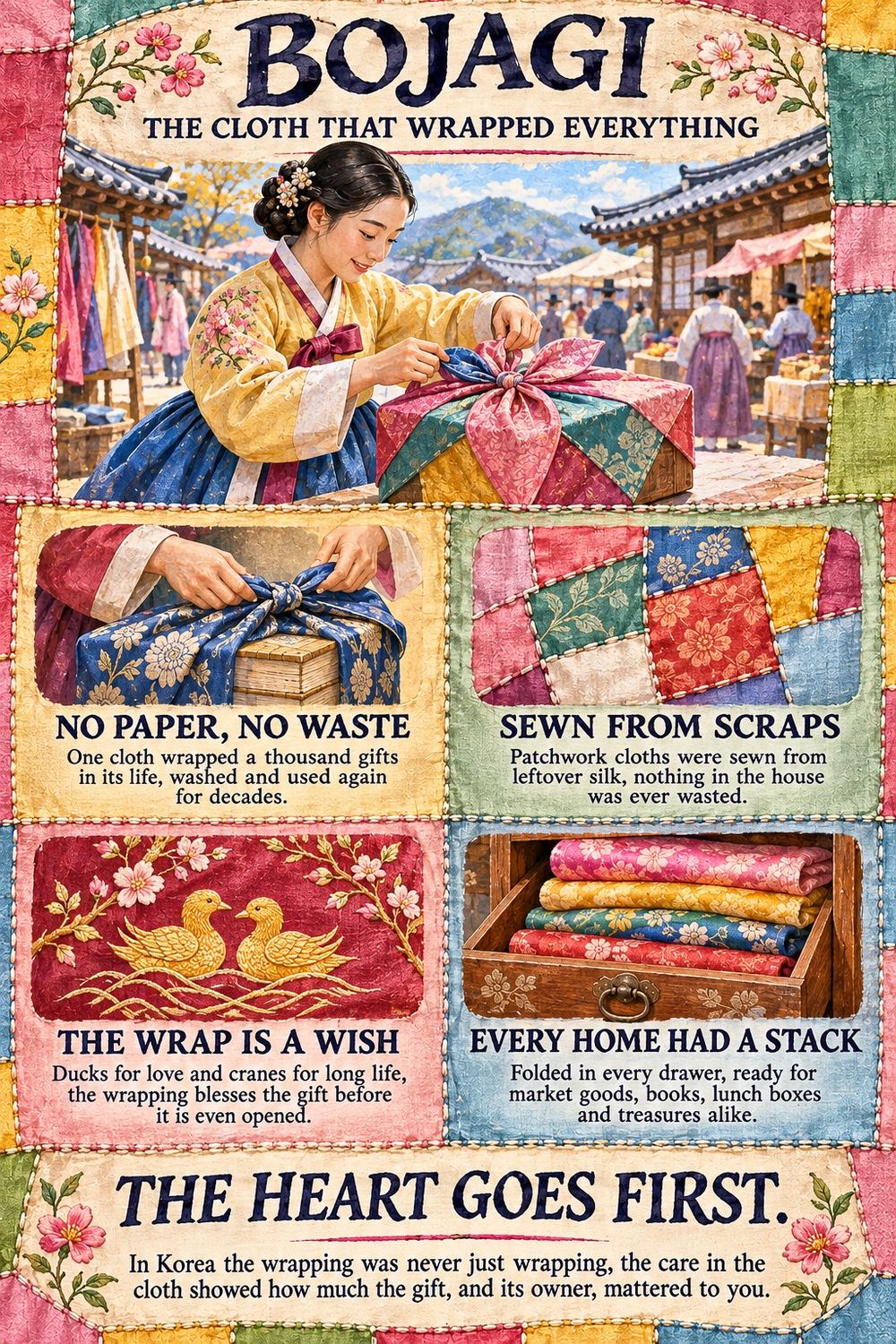
Bojagi: The Korean Cloth That Wrapped Everything
Bojagi are Korean wrapping cloths — square cloths used to wrap, carry, cover and store almost anything, from gifts and books to food and household goods. The poster frames itself as patchwork, with a market scene of a woman tying a bright cloth around a box. No Paper, No Waste: one cloth wrapped a thousand gifts in its life, washed and used again for decades, long before reusable wrapping was a modern idea. Sewn From Scraps: patchwork bojagi (jogakbo) were sewn from leftover silk and other fabric scraps, so nothing in the house was wasted, and the patchwork itself became a respected form of women's needlework. The Wrap Is a Wish: embroidery carried meaning, ducks for love and cranes for long life, so the wrapping blessed the gift before it was opened. Every Home Had a Stack: cloths were folded in every drawer, ready for market goods, books, lunch boxes and treasures alike. The footer, The Heart Goes First, states the etiquette: the care in the cloth showed how much the gift, and its receiver, mattered to you. See the pin on Pinterest.
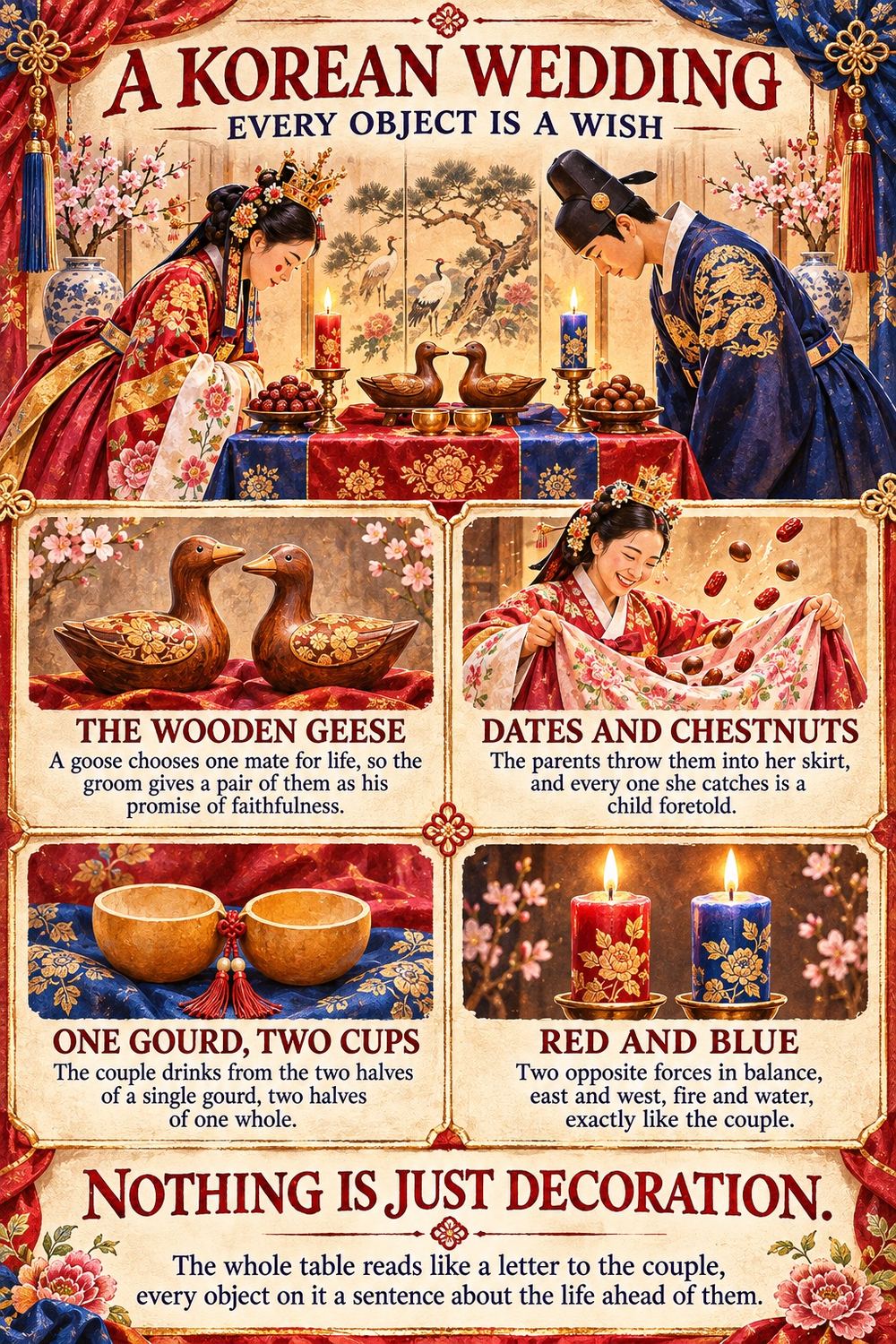
A Traditional Korean Wedding: Every Object Is a Wish
In a traditional Korean wedding, and in the pyebaek ceremony that follows, where the couple bows to the groom's parents, the table is a set of symbols, not decorations. The top scene shows bride and groom bowing across a red-and-blue table with candles, geese and bowls. The Wooden Geese (kirogi): a goose or mandarin duck was understood to choose one mate for life, so the groom gave a pair as his promise of faithfulness, and the pair later lived in the couple's home. Dates and Chestnuts: in pyebaek the parents throw dates (jujubes) and chestnuts into the bride's outstretched skirt cloth, and every one she catches was read as a child foretold — dates and chestnuts standing for children and family continuity. One Gourd, Two Cups: the couple drinks from the two halves of a single gourd, two halves of one whole. Red and Blue: the two candles, and the couple's clothing, pair red and blue for two opposite forces in balance — east and west, fire and water — exactly like the couple. The footer reads the whole table as a letter to the couple, every object a sentence about the life ahead of them. See the pin on Pinterest.
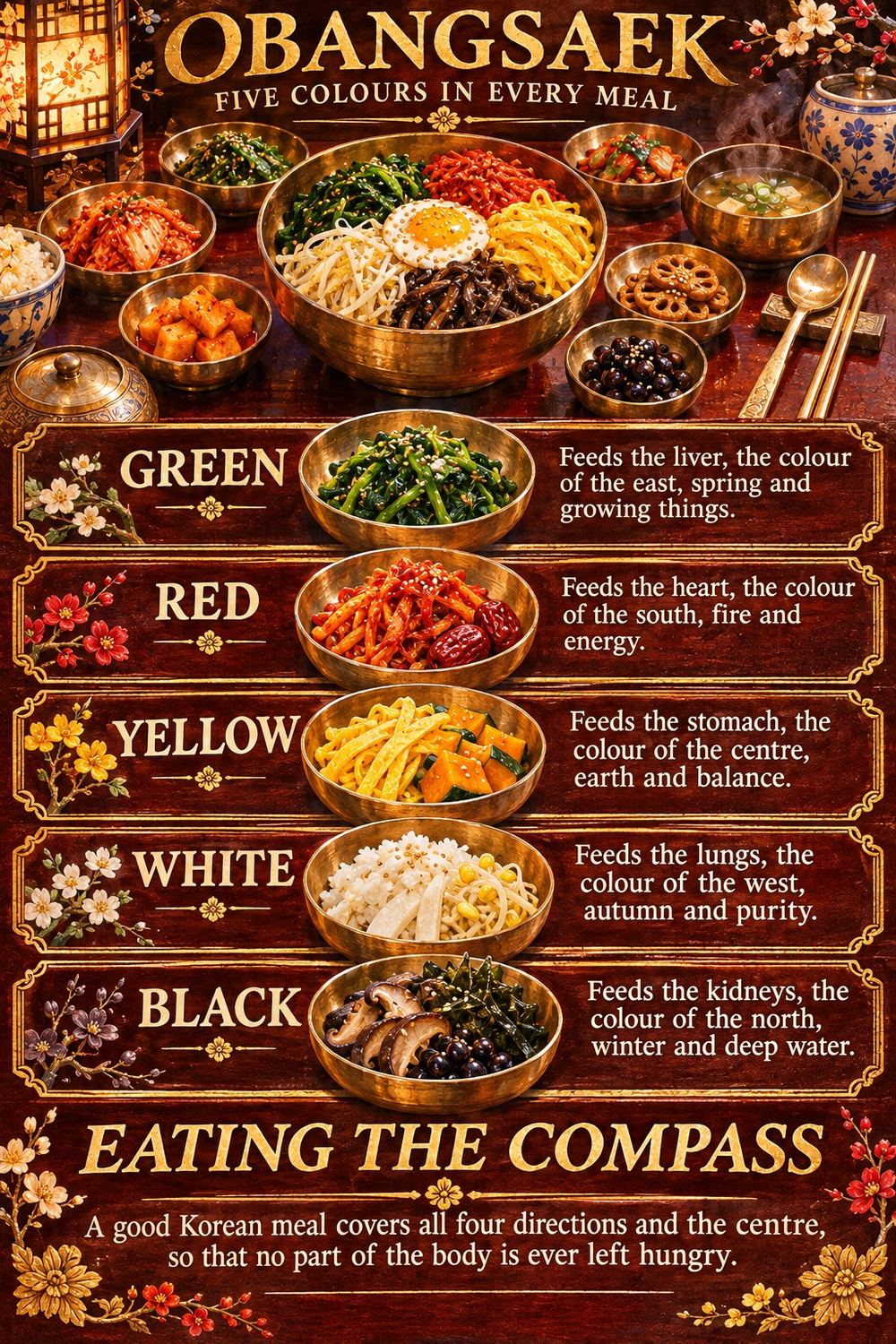
Obangsaek: Five Colours in Every Korean Meal
Obangsaek is the five-colour scheme — the same directional system seen in dancheong — applied to food, which is why a bowl of bibimbap looks like a painter's palette. The poster opens on a brass bowl of bibimbap topped with a fried egg, surrounded by banchan, then lists each colour with the organ it was traditionally said to feed, following the five-element ideas long used in East Asian food philosophy. Green feeds the liver, the colour of the east, spring and growing things, shown as seasoned greens. Red feeds the heart, the colour of the south, fire and energy, shown as a red seasoned dish with jujubes. Yellow feeds the stomach, the colour of the centre, earth and balance, shown as egg strips and squash. White feeds the lungs, the colour of the west, autumn and purity, shown as rice and bean sprouts. Black feeds the kidneys, the colour of the north, winter and deep water, shown as mushrooms, seaweed and black beans. The footer, Eating The Compass, sums up the aim: a good meal covers all four directions and the centre, so no part of the body is left out. See the pin on Pinterest.
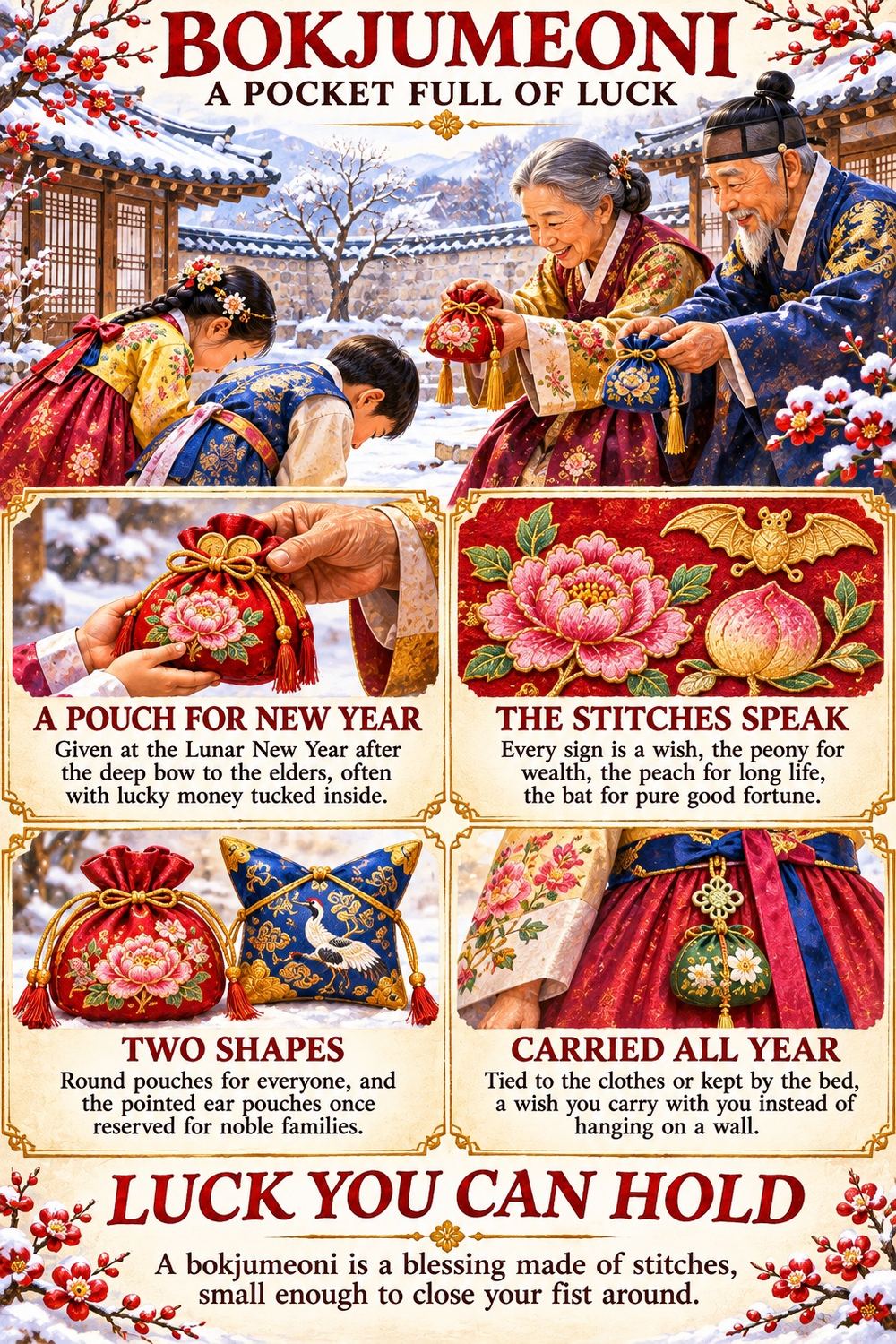
Bokjumeoni: The Korean Lucky Pouch, a Pocket Full of Luck
A bokjumeoni is a small embroidered silk pouch for holding luck — and, at Seollal (Lunar New Year), often lucky money. The poster, 'A Pocket Full of Luck', opens in a snowy courtyard where children in hanbok make the deep bow (sebae) to their grandparents, and the elders hand them pouches in return, the classic moment when sebaetdon, New Year money, changes hands. A Pouch For New Year shows the handover close up: given after the bow, often with lucky money tucked inside. The Stitches Speak shows the embroidery enlarged — a peony, a peach and a gold bat: every sign is a wish, the peony for wealth, the peach for long life, the bat for pure good fortune, because the bat is a traditional luck symbol. Two Shapes compares the forms: round pouches (dunggeun jumeoni) for everyone, and the pointed, ear-shaped pouches (gwijumeoni) once reserved for noble and royal families. Carried All Year shows a pouch tied to a hanbok skirt: tied to the clothes or kept by the bed, a wish you carry with you instead of hanging on a wall. The footer calls it luck you can hold — a blessing made of stitches, small enough to close your fist around. See the pin on Pinterest.
That completes the twelve. You can see all of them together on the “South Korea” board on the Burek Lab Pinterest, and find more designs in the Burek Lab Etsy shop.