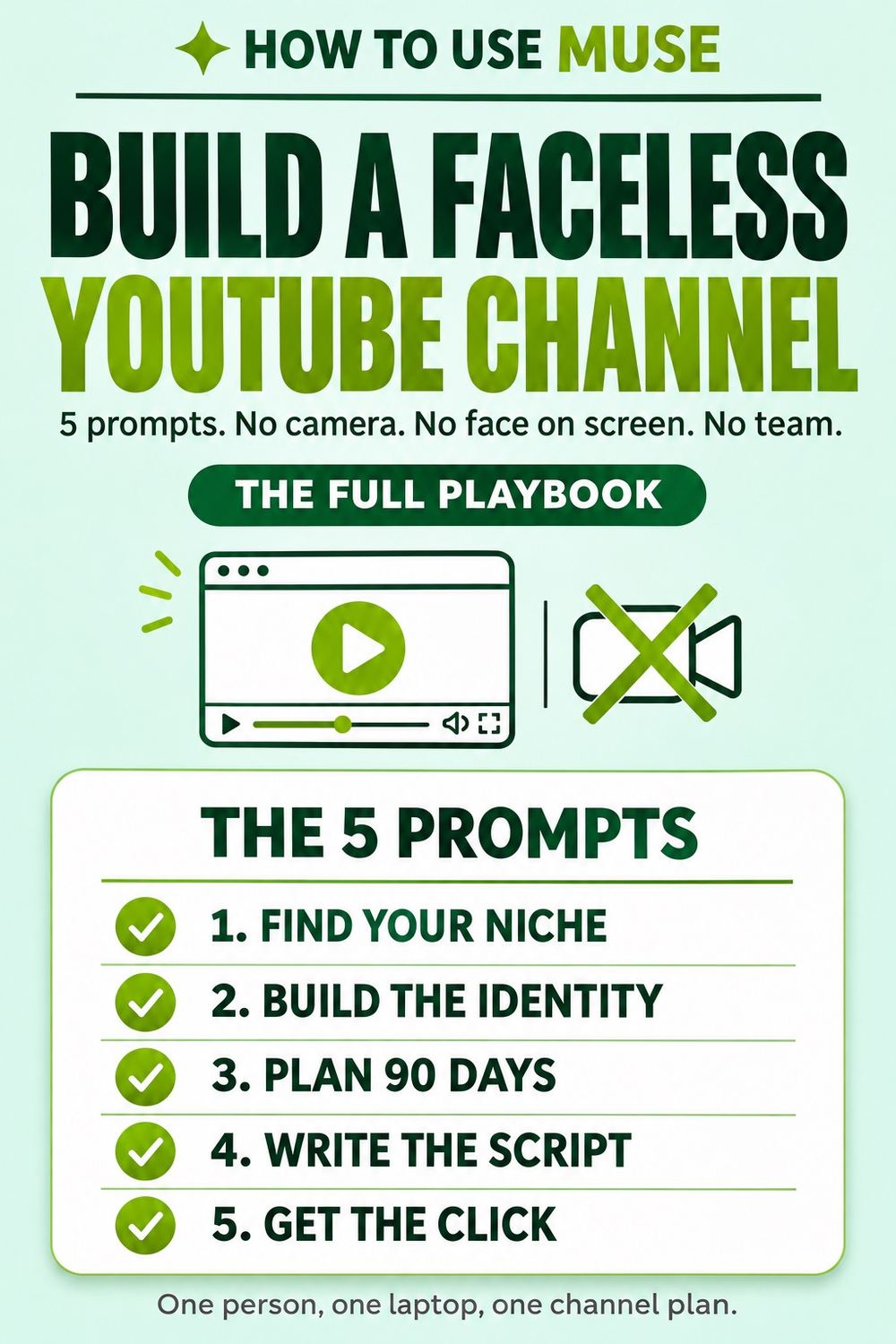
You want a YouTube channel, but you do not want your face on the internet, a camera setup in the corner, or a ring light judging you. Good news: some of the biggest channels on YouTube have no presenter at all. The voice, the format and the editing do the whole job. What those channels have, and most beginners do not, is a plan made before video one.
This @musemadeasy playbook builds that plan with five copy-paste Muse prompts, run in order: find the niche, build the identity, plan 90 days, write the script, and package the click. One person, one laptop, no camera bought. Here are all five prompts in full, with the poster for each step.
How to run the playbook
- One prompt at a time — copy a prompt into Muse, answer its questions honestly, and save the output. Each prompt feeds the next one.
- Keep everything — the niche list, the identity, the roadmap. Prompt 3 needs the output of prompt 2, and prompt 5 needs the script from prompt 4.
- Stay original — faceless does not mean reuploading other people's clips. YouTube rejects reused content, and so does this playbook.
Prompt 1: Find your faceless niche
Most faceless channels die before video one: the niche secretly needs a face, or it pays almost nothing. This prompt makes Muse rank the niches against your real life first: what you know, your free hours, and your voice choice.
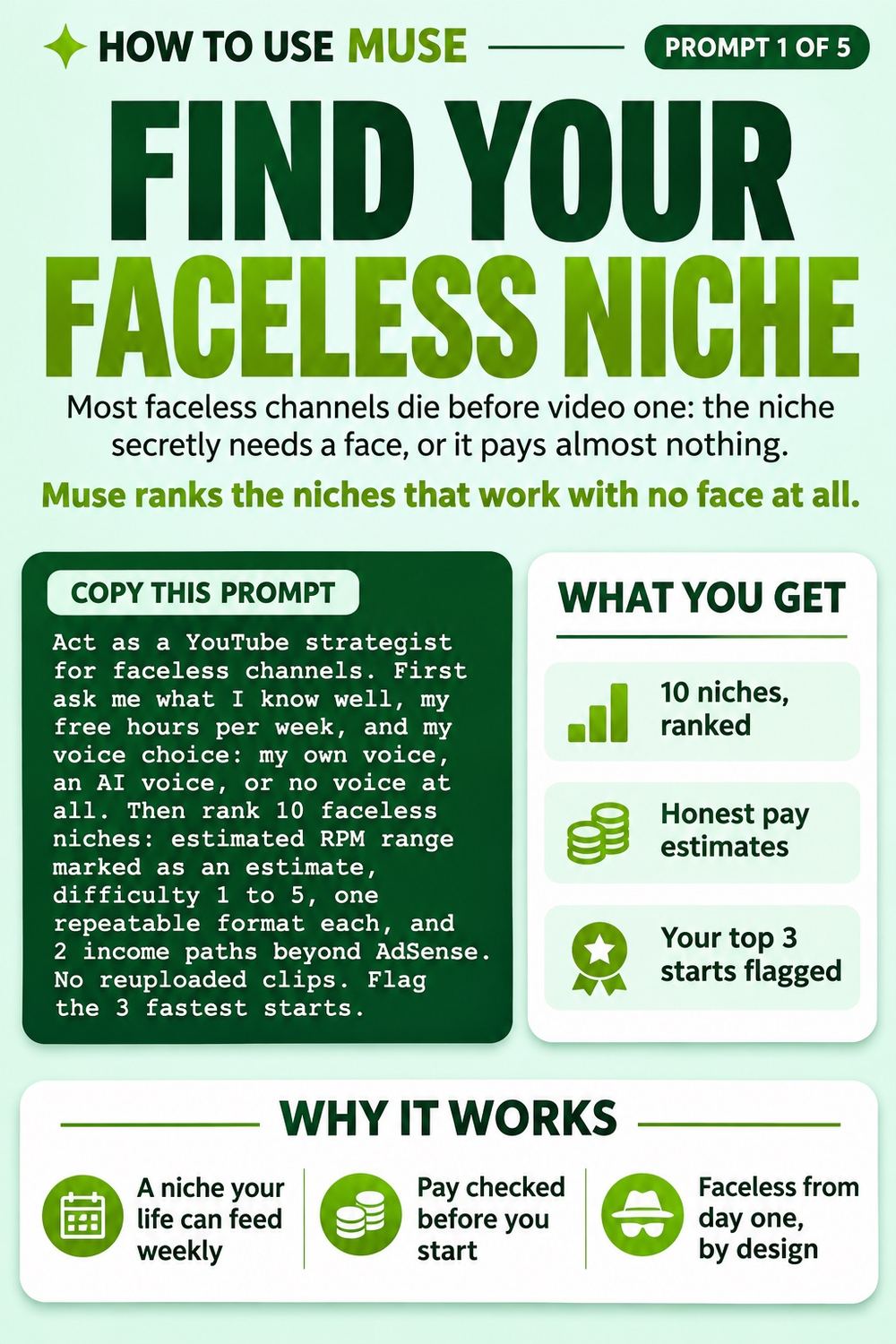
ROLE: Act as a YouTube strategist who specialises in faceless channels run by one person with no camera, no studio and no team.
TASK: Give me a ranked list of faceless channel niches I can realistically start from zero.
STEPS:
1. First ask me three things: topics I already know or enjoy, how many hours a week I can work, and whether I will use my own voice, an AI voice, or no voice at all.
2. Suggest 10 niches where the face never matters: the value is in the story, the screen, the list, the tutorial or the sound.
3. For every niche give an estimated RPM range and mark it clearly as an estimate, a difficulty rating from 1 to 5, and one production format I can repeat every week.
4. Name at least two ways to earn beyond AdSense for each niche.
5. Rank all 10 by opportunity, weighing earnings against competition and production effort.
RULES: Every niche must work fully faceless. No niches built on reuploading other people's clips, YouTube rejects that as reused content. Ranking must be honest, never tell me all 10 are great. Flag the 3 niches a beginner can produce fastest.
OUTPUT: A ranked table of 10 niches with RPM estimate, difficulty, production format and extra income paths, plus your top 3 picks for me with one sentence why.
Prompt 2: Build the channel identity
With no presenter, the format is the personality. This prompt builds the whole identity around that: names, a tagline, the narrator persona, content pillars, and the one repeatable format viewers recognise in the first ten seconds.
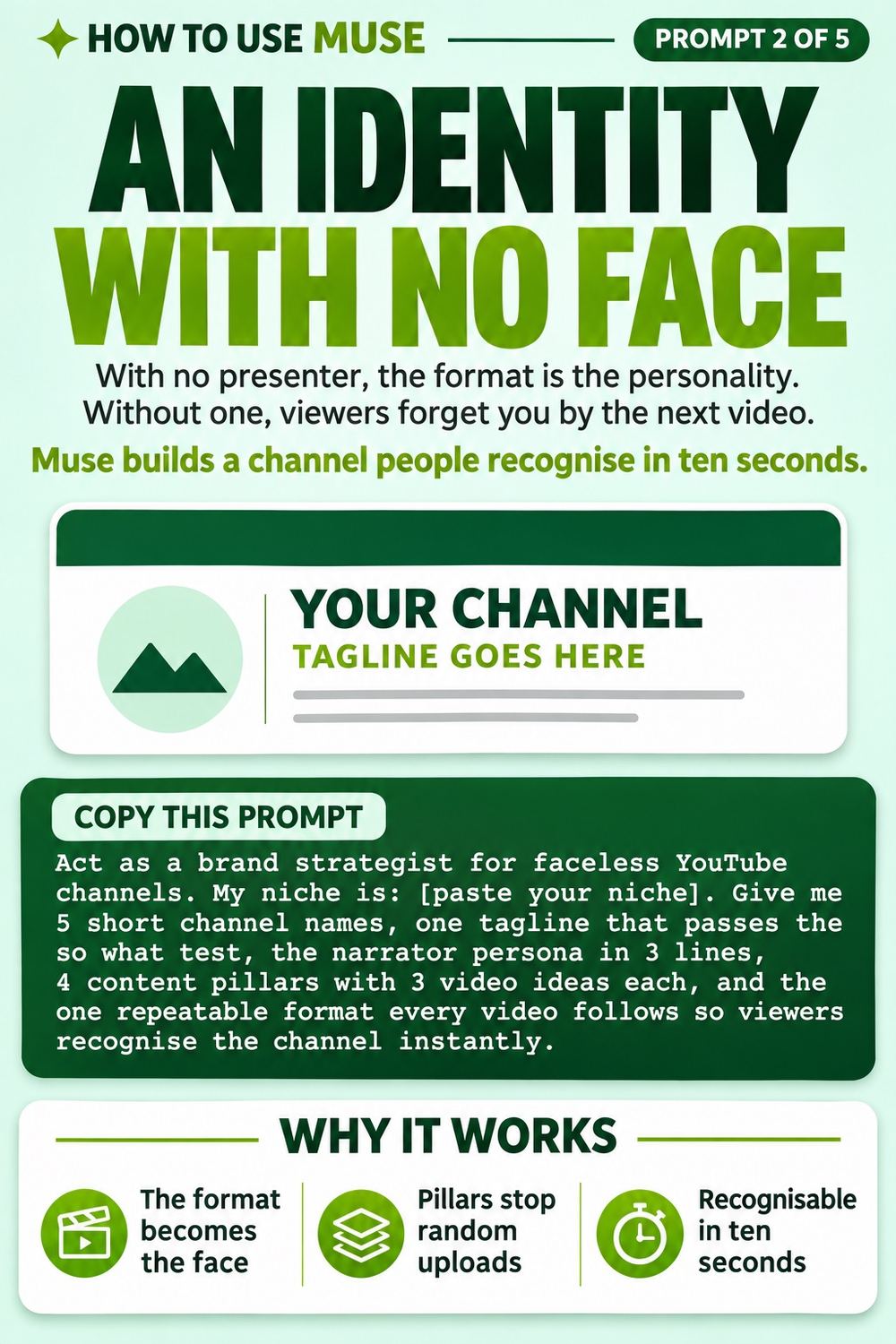
ROLE: Act as a brand strategist for faceless YouTube channels, where the format and the voice are the personality, not a person.
TASK: Build a complete channel identity for my chosen niche: [paste the niche from Prompt 1].
STEPS:
1. Give me 5 channel name options that are short, easy to spell after hearing them once, and not copied from existing big channels.
2. Write one tagline that tells a stranger in five seconds what every video gives them.
3. Define the channel persona: tone of voice, pace, and the kind of narrator the viewer feels they know, without any face on screen.
4. Build 4 content pillars that never overlap, each with 3 example video ideas.
5. Name my repeatable format, the one structure every video follows so viewers recognise my channel in the first 10 seconds.
RULES: The identity must work with zero personal branding: no name, no face, no life story. Pillars must be producible with stock footage, screen recordings, simple animation or AI images. The tagline must pass the "so what" test: if a viewer can shrug at it, rewrite it.
OUTPUT: 5 names, 1 tagline, the persona in 3 lines, 4 content pillars with examples, and the repeatable format in one paragraph.
Prompt 3: Plan your first 90 days
Random uploads bury new channels. This prompt turns the identity into an order: 12 videos that build on each other, so watch time compounds instead of resetting with every upload.
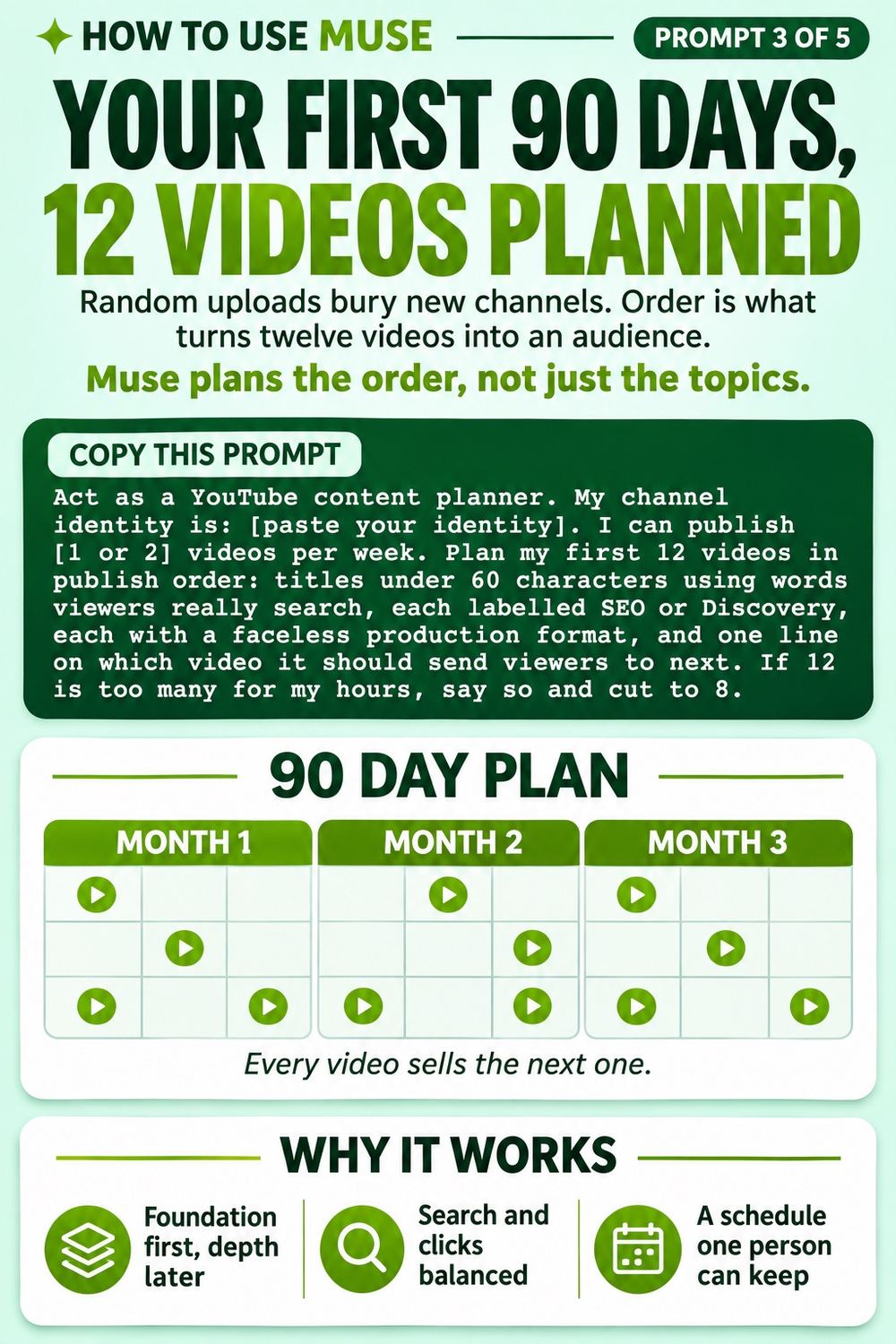
ROLE: Act as a YouTube content planner who builds 90 day roadmaps for small faceless channels that grow step by step.
TASK: Plan my first 12 videos for this channel: [paste the identity from Prompt 2]. I can publish [one or two] videos per week.
STEPS:
1. Write 12 video titles using words real viewers type into YouTube search, each under 60 characters where possible.
2. Label each video SEO priority (built to be found in search) or Discovery priority (built to be clicked from the home page).
3. Put them in publish order: foundation topics first, then deeper topics, then one opinion or story video that shows personality.
4. For each video add the production format: voiceover and stock, screen recording, list with images, or story narration.
5. Add one line per video on what it must make the viewer do next: watch another video, subscribe, or comment.
RULES: No random topics, every video builds on the ones before it. Every title must be producible fully faceless. Keep the schedule honest for one person: if 12 videos in 90 days is too much for my hours, say so and cut to 8.
OUTPUT: A week by week table: publish order, title, SEO or Discovery label, production format, and the next action it drives.
Prompt 4: Write the full script
No presenter means the words and the visuals do all the holding. This prompt writes both together, in a two column script you can record and edit without guessing what goes where.
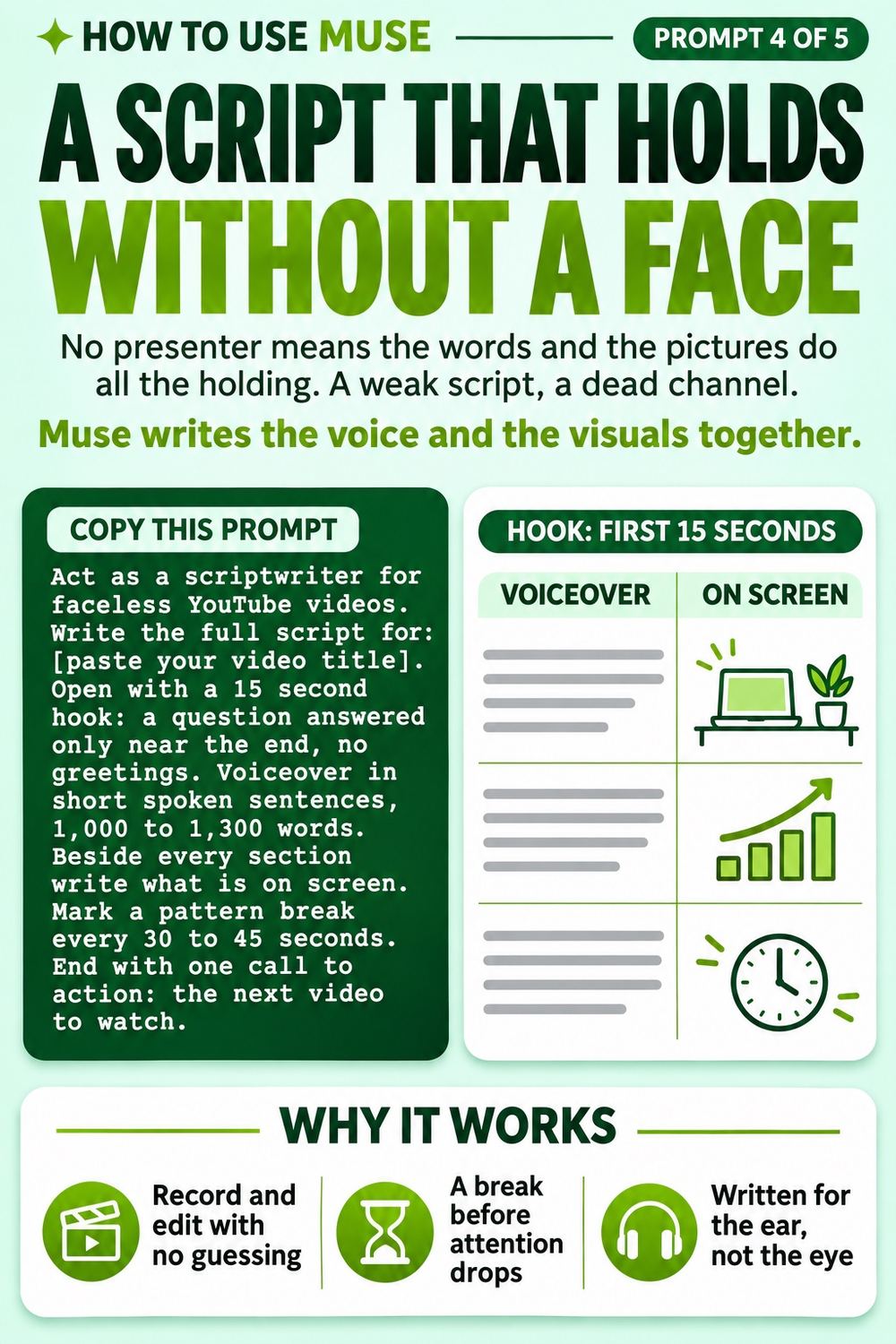
ROLE: Act as a YouTube scriptwriter for faceless videos that hold attention with voice, visuals and pacing instead of a presenter.
TASK: Write the complete script for this video: [paste one title from Prompt 3].
STEPS:
1. Write the first 15 seconds as a hook that opens a question the video only answers near the end. No greetings, no channel intro.
2. Write the voiceover script in short spoken sentences: hook, problem made personal, main content in 3 clear sections, one surprising fact or turn, and an ending that loops back to the opening question.
3. Next to every section, write the visual direction: what is on screen while those words are spoken (stock clip idea, screen recording, image, or on screen text).
4. Mark the exact places for a pattern break every 30 to 45 seconds: new visual, new question, or a short pause line.
5. End with one call to action only: point to the one next video the viewer should watch, by title.
RULES: Total length about 1,000 to 1,300 words of voiceover, roughly 8 to 10 minutes spoken. No filler phrases like "in this video" or "without further ado". Every visual direction must be something I can legally use: stock libraries, my own recordings, or images I generate. Write for the ear, not the eye: if a sentence sounds stiff read aloud, rewrite it.
OUTPUT: The full script as a two column table: voiceover text on the left, visual direction on the right, with hook, sections, pattern breaks and the final call to action marked.
Prompt 5: Titles, thumbnails and SEO
No shocked face to copy, so the click has to come from a strong object, a bold claim and three words of text. This prompt builds the whole click and search package for one finished video.
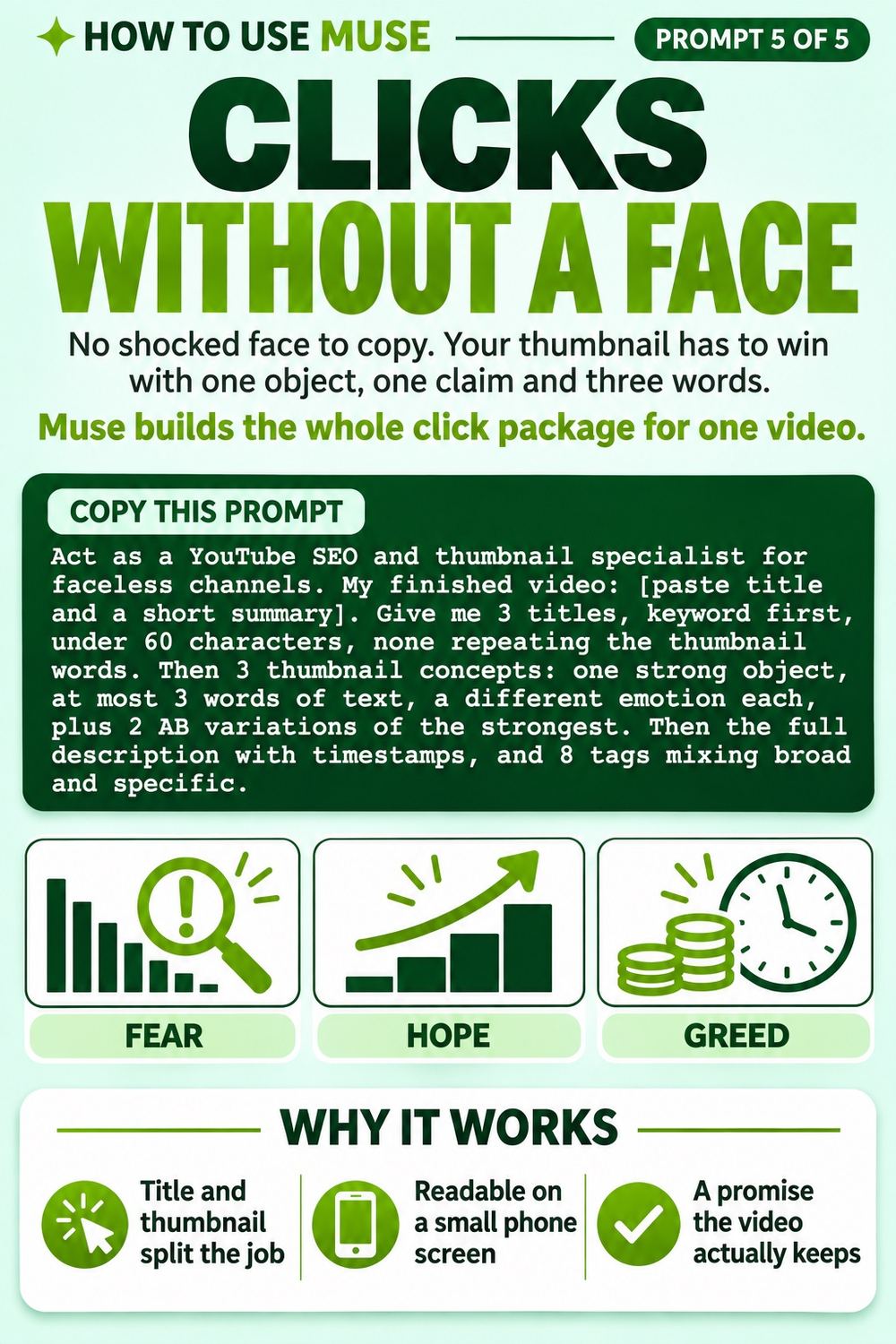
ROLE: Act as a YouTube SEO and thumbnail specialist for faceless channels, where the click comes from a strong object, a bold claim and three words of text, never from a face.
TASK: Build the full click and search package for this finished video: [paste the title and a 3 sentence summary of the script].
STEPS:
1. Rewrite my title into 3 options, keyword first, each under 60 characters, each promising one clear thing.
2. Create 3 thumbnail concepts. Each one: one strong object or scene, at most 3 words of text, one emotional trigger, and colours that stay readable on a phone screen.
3. For the strongest concept, give me 2 AB test variations and say exactly what changes between them.
4. Write the full description: first 2 sentences work alone as a summary with the main keyword, then a short paragraph, then timestamps from my script sections, then one call to action.
5. Give me 8 tags mixing broad terms and long specific phrases a small channel can actually rank for.
RULES: No faces in any thumbnail concept, and no shocked expression clichés. Thumbnail text and title must not repeat the same words. No clickbait the video does not deliver. Tags must all be relevant: no big creator names, no misleading terms.
OUTPUT: 3 titles, 3 thumbnail concepts with the AB variations, the full description, and 8 tags.
The whole channel, in one sitting
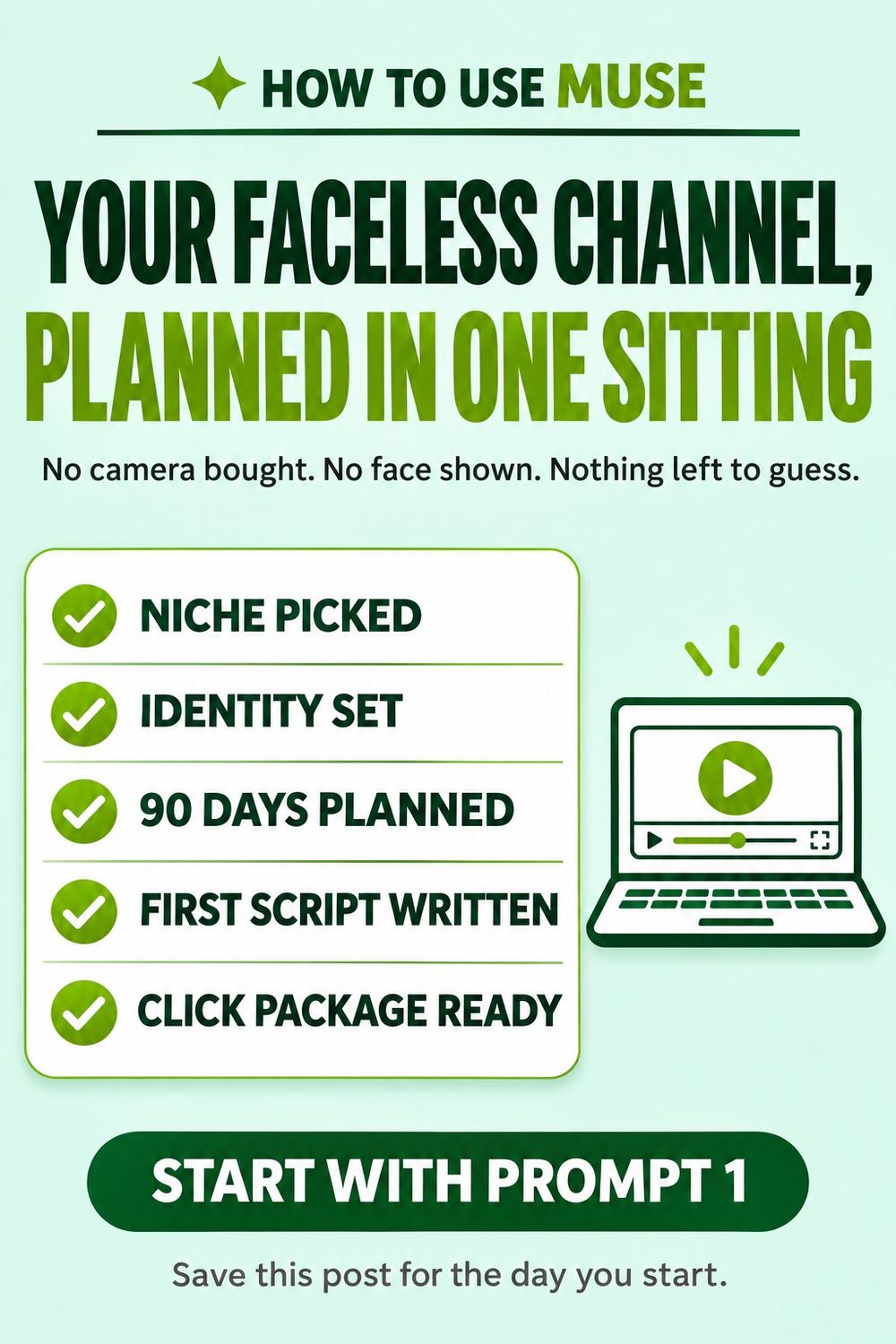
Run the five prompts in order and the plan is complete: niche picked, identity set, 90 days planned, first script written, click package ready. The only step left is the one no prompt can do for you: record video one.
Frequently asked questions
Do I need my own voice?
No. Prompt 1 asks you to choose at the start: your own voice, an AI voice, or no voice at all with on screen text and music. The plan is built around whichever you pick.
Are the RPM numbers real?
They are estimates, and the prompt forces Muse to label them as estimates. Real earnings depend on the niche, the country of your viewers and the season. Treat the numbers as a way to compare niches, not as a promise.
Can one person really keep this schedule?
That is exactly what prompt 3 checks. If 12 videos in 90 days does not fit your free hours, Muse has to say so and cut the plan to 8. A smaller plan you finish beats a big one you abandon.
One useful Muse trick at a time
That is the whole idea of Muse Made Easy: one real problem, one prompt, one result. Follow along for the next one.